Since the Companies (Amendment) Act 2024 introduced Division 8A into the Companies Act 2016 (CA 2016), every Sdn Bhd in Malaysia must identify, record, and report its Beneficial Owner(s).
What Is a Beneficial Owner (BO)?
Under Section 2(a) and Section 60A(1) of the Companies Act 2016, a Beneficial Owner is defined as:
- In relation to shares: the ultimate owner of those shares — not a nominee
- In relation to a company: a natural person who ultimately owns or controls the company, including anyone who exercises ultimate effective control
The key point is this: you do not need to be a registered shareholder or a named director to be classified as a Beneficial Owner. If you hold real influence over a company’s decisions or enjoy the underlying economic benefit of its shares, you may qualify as one.
Who Qualifies as a Beneficial Owner?
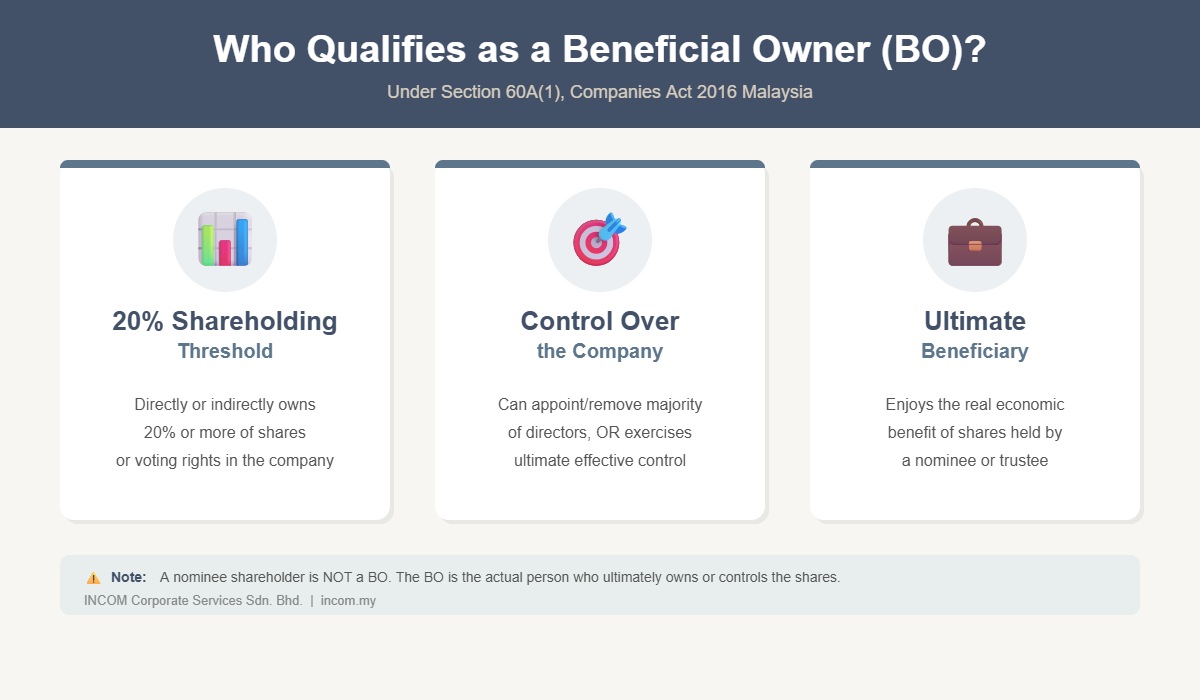
An individual may be identified as a BO if any of the following apply:
- They directly or indirectly own 20% or more of the shares or voting rights
- They have the power to appoint or remove a majority of directors
- They exercise ultimate effective control through contractual arrangements, understandings, or other mechanisms — even without holding shares
- They are the ultimate beneficiary of shares held through a nominee, trust, or corporate entity
The 20% threshold is a starting point, not the full picture. BO status is assessed holistically — ownership and control both matter.
What About Nominee Shareholders?
A nominee shareholder is not a Beneficial Owner. A nominee holds shares on behalf of another person and does not possess the ultimate economic benefit. The BO is the actual underlying person — the one who ultimately enjoys the benefit or exercises control over those shares.
This distinction is critical. If your company has nominee shareholding arrangements in place, you must trace through to the ultimate natural person and record them as the BO.
What Is “Control” Under the BO Rules?
“Control” under the CA 2016 BO framework generally means the capacity to influence or direct important decisions about the company. This includes:
- The ability to appoint or remove a majority of the board of directors
- Exercising substantial influence through contracts, shareholders’ agreements, or other arrangements
- Controlling the company without holding any shares or formal position
Your Company’s Obligations: What Must Your Sdn Bhd Do?
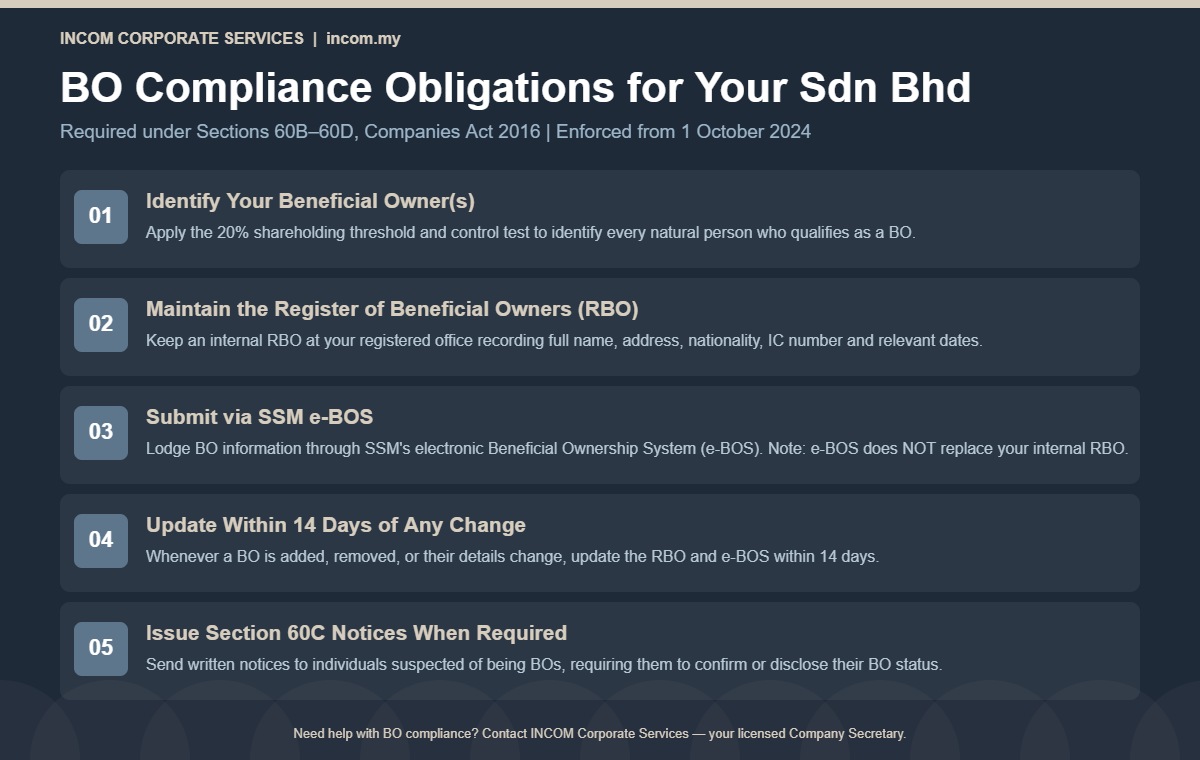
Under Sections 60B to 60D of the Companies Act 2016, every Sdn Bhd in Malaysia must:
- Identify its Beneficial Owner(s) using the shareholding threshold and control tests
- Maintain an internal Register of Beneficial Owners (RBO) at its registered office
- Update the RBO within 14 days of any change in BO information
- Submit BO information via SSM’s e-BOS (electronic Beneficial Ownership System)
- Issue notices under Section 60C to individuals suspected of being BOs, requiring them to confirm or disclose their BO status
What Must the RBO Record?
The internal Register of Beneficial Owners must contain, at a minimum:
- Full name, address, nationality, and identification number (NRIC or passport)
- Date the individual became a BO
- Date the individual ceased to be a BO (where applicable)
Important: Submitting to e-BOS does not replace your obligation to maintain the internal RBO. Both must be kept and updated independently.
Is BO Information Made Public?
No — Beneficial Owner information is confidential and not available for public inspection. Access is restricted to:
- Competent authorities and enforcement agencies (e.g. MACC, PDRM, BNM)
- Regulatory bodies and reporting institutions under AML/CFT laws
- Persons specifically authorised by the Minister
Penalties for Non-Compliance
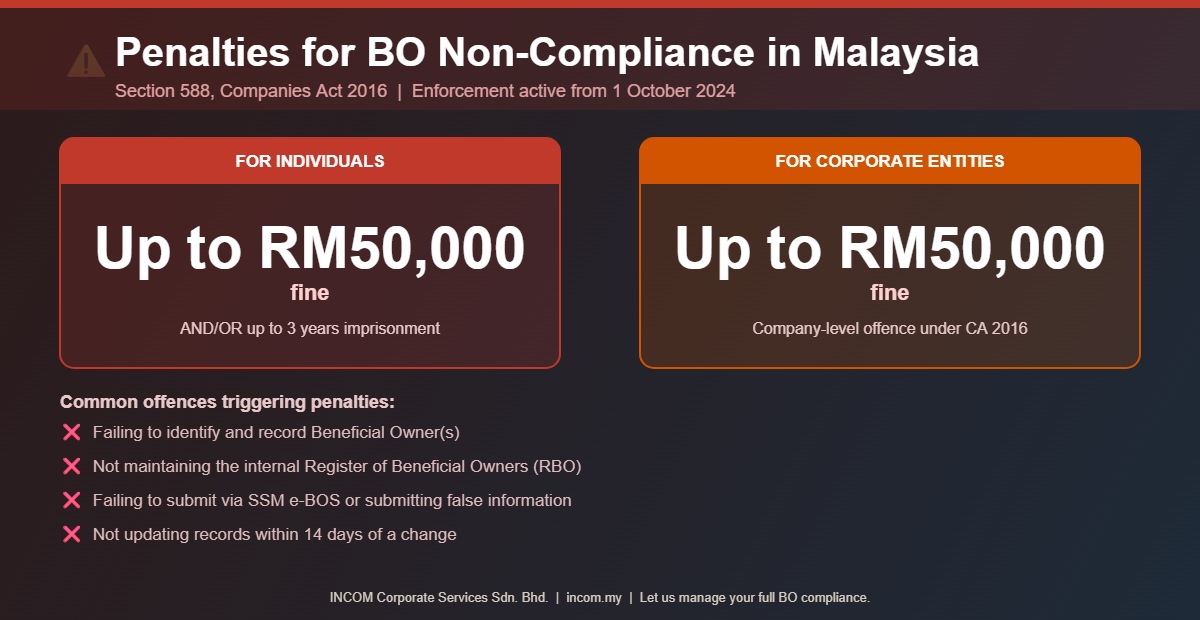
Failure to comply with BO obligations is a criminal offence under Section 588 of the Companies Act 2016. The penalties are:
- Individuals: Fine up to RM50,000 and/or imprisonment up to 3 years
- Corporate entities: Fine up to RM50,000.
How INCOM Can Help
Beneficial Ownership compliance involves identifying the right individuals, maintaining accurate and current records, and making timely submissions to SSM. Missing any step can expose your directors to personal criminal liability.
At INCOM Corporate Services, our licensed Company Secretaries manage your full BO compliance — from identifying your BOs and setting up your internal RBO, to filing via e-BOS and keeping your records updated whenever there is a change.
Contact us at incom.my to make sure your Sdn Bhd is fully compliant and protected.
Frequently Asked Questions
Does every Sdn Bhd need to comply with BO requirements?
Yes. The BO obligations under Division 8A of the CA 2016 apply to all companies incorporated in Malaysia, including private limited companies (Sdn Bhd). There is no minimum size or revenue threshold — all Sdn Bhds must comply.
Can a company have more than one Beneficial Owner?
Yes. If multiple individuals each independently meet the BO criteria — for example, two shareholders each holding 20% or more — all of them must be recorded as Beneficial Owners in the RBO and reported to SSM via e-BOS.
What is e-BOS and is it the same as the internal RBO?
e-BOS is SSM’s online portal for companies to submit BO information electronically. It is a submission platform, not a substitute for your company’s internal RBO. You must maintain both: the internal RBO (kept at your registered office) and make filings via e-BOS. Your Company Secretary typically handles both.
What if our company is 100% owned by a foreign holding company?
You must trace through the foreign holding company’s ownership structure to identify the ultimate natural person(s) who own or control it. Foreign-owned Sdn Bhds are not exempt. Your Company Secretary can assist in gathering the required information from the foreign parent entity.