
Is your company secretary slow to respond, missing compliance deadlines, or leaving you in the dark about your statutory obligations? You are not alone. Many Sdn Bhd owners in Malaysia eventually reach a point where they need to make a change — and the good news is, switching your company secretary is entirely legal and manageable when done correctly.
Under the Companies Act 2016, every Sdn Bhd in Malaysia must maintain a licensed/qualified company secretary at all times. But that does not mean you are locked in with a provider that is not delivering. This guide explains the full process of changing your company secretary in Malaysia — from the legal requirements to the step-by-step procedure and what to expect during the transition.
Is It Legal to Change Your Company Secretary?
Yes, absolutely. A Sdn Bhd may change its company secretary at any time. The Companies Act 2016 does not restrict you from replacing your current secretary, provided that:
- The company always maintains at least one qualified company secretary
- The new secretary holds a valid licence from SSM and is a member of a recognised professional bodies
- The new secretary has their principal place of residence in Malaysia
- The change is properly documented and lodged with SSM
There is no need to wait for a contract to expire. As long as the transition is handled correctly, your company will remain fully compliant throughout the change.
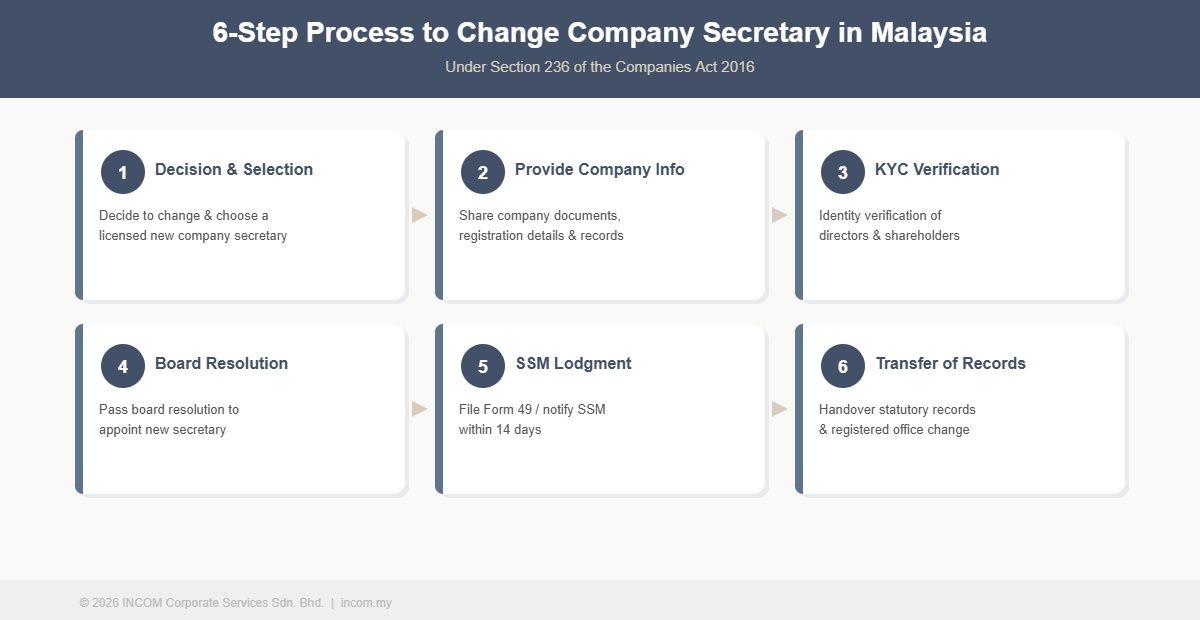
Step-by-Step Process to Change Company Secretary in Malaysia
Step 1: Decide to Make the Change and Choose a New Secretary
The directors of the company should agree to change the company secretary. Spend time evaluating prospective firms — consider their licensing, responsiveness, service scope, digital capabilities, and fee transparency. Look for a secretary who offers proactive compliance support, not just reactive document filing.
Step 2: Provide Company Information to the New Secretary
The incoming company secretary will conduct due diligence before accepting the appointment. This is a professional obligation — your new secretary is personally responsible to the company once appointed. You will typically need to provide:
- Company name and registration number
- Date of incorporation
- Name and contact of the current company secretary
- Full particulars (name, NRIC or passport, contact details, residential address) of all directors and shareholders
- Proof of Malaysian residency for directors (tenancy agreement, utility bill, or S&P agreement in the director’s name)
- Valid visa documentation for foreign directors residing in Malaysia
In most cases, the incoming secretary will liaise directly with the outgoing secretary to coordinate the transition.
Step 3: Identity Verification (KYC)
The new company secretary is required to verify the identities of your directors and shareholders — a process known as KYC (Know Your Customer). This is a statutory and anti-money laundering obligation.
Step 4: Pass the Board Resolutions
Generally, your new company secretary will prepare the necessary Board Resolutions for the directors to sign. Two key resolutions are required:
- Board Resolution for the Resignation of the Existing Company Secretary
- Board Resolution for the Appointment of the New Company Secretary
The new secretary will also sign a Consent to Act as Company Secretary, confirming their acceptance of the appointment and their eligibility to serve.
Step 5: Lodgment of Change with SSM
The incoming company secretary to lodge reassignment of COSEC with SSM via the MyCoID . Once reassignment approved, new secretary to lodge the resignation and appointment of company secretary with the SSM.
Step 6: Transfer of Statutory Records and Change of Registered Office
The outgoing secretary must hand over all company statutory records and documents to the new secretary. This includes:
- Statutory registers (Register of Directors, Register of Members, Register of Charges)
- Company constitution and incorporation documents
- Minutes books and board resolutions
- Share certificates and transfer forms
- Historical SSM filing records
Since the company secretary’s office typically serves as the company’s registered office, the change in secretary also requires a Board Resolution to change the registered office address from the outgoing secretary’s address to the new secretary’s address. This is then lodged with SSM accordingly.
How Long Does It Take?
A company secretary change typically takes between 3 to 14 working days, depending on the responsiveness of the outgoing secretary, the completeness of documents provided, and SSM’s processing timeline. Settling any outstanding fees with the outgoing secretary early and communicating your intention to switch clearly will help speed things along.
What Happens to Your Compliance During the Transition?
Your compliance obligations do not pause during a secretary change. Any Annual Return deadlines, resolutions, or SSM filings that fall due during the transition period must still be met. A professional incoming secretary will flag these immediately and ensure nothing is missed during the handover period. Always clarify in writing which secretary is responsible for filings that fall due during the changeover — do not assume.
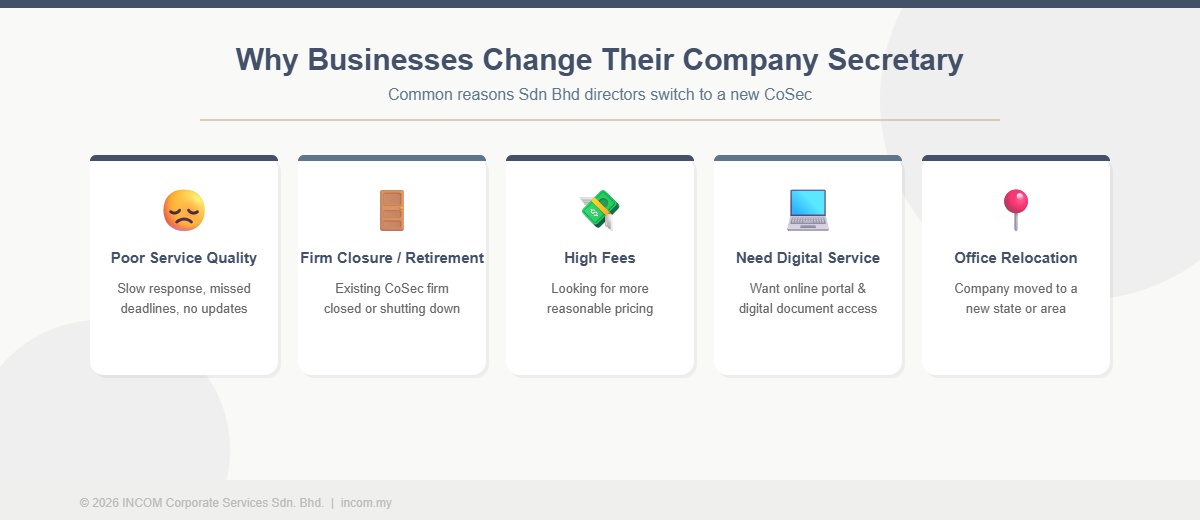
Signs It Is Time to Make a Change
Not sure if your situation warrants a switch? These are the clearest signs that your current company secretary is no longer serving your best interests:
- You have received an SSM penalty or compound due to a late filing
- You cannot get a response within a reasonable timeframe
- You do not receive advance notice of upcoming compliance deadlines
- Your statutory documents are not in order or are inaccessible
- You are being charged unexpected fees that were not agreed upfront
- You receive little or no advisory support on corporate governance matters
Switch to INCOM — Professional, Digital, and Transparent
At INCOM Corporate Services Sdn. Bhd., we believe company secretarial services should be transparent, responsive, and digitally accessible. We are a licensed company secretarial firm founded by a chartered secretary, combining professional advisory expertise with efficient digital processes for every client we serve.
When you switch to INCOM, here is what you can expect:
- Smooth transition management: We coordinate with your outgoing secretary, prepare all required documents, and lodge the change with SSM on your behalf.
- Proactive compliance reminders: We track your Annual Return deadlines and all other statutory obligations so you never miss a filing.
- Professional advisory support: Beyond compliance, we advise on share structure, corporate changes, and governance matters relevant to your business stage.
- Digital-first service: Resolutions, documents, and communications are handled digitally — no unnecessary office visits required.
- Transparent and reasonable fees: No hidden charges. Our pricing is clear, fair, and competitive.
Ready to make the switch? Contact INCOM Corporate Services today and let us handle your company secretary transition — seamlessly, professionally, and fully compliant with the Companies Act 2016.