
You registered your Sdn Bhd with the best intentions — a business idea full of promise. But plans changed. The company never traded, activity stopped, or operations were put on hold. Now it sits there, inactive, and you are not sure what to do with it.
This is the reality for many business owners in Malaysia. A dormant company feels like a non-issue — after all, if nothing is happening, surely there is nothing to worry about? That assumption is exactly where many directors go wrong, and where penalties begin to accumulate.
A dormant Sdn Bhd in Malaysia still carries legal obligations under the Companies Act 2016 and the Income Tax Act 1967. The law does not pause simply because your business activity has. This guide explains clearly what dormant status means, what you are still required to do, and what options are available to you.
What Is a Dormant Company in Malaysia?
Under the Companies Act 2016, a company is considered dormant when it has had no accounting transactions during a financial year.
In plain terms — if your company has no revenue, no expenses, no contracts, and no bank transactions beyond routine maintenance costs, it may qualify as a dormant company.
It is also important to understand that SSM and LHDN define dormancy slightly differently. SSM focuses on accounting transactions; LHDN may consider a company dormant if it has ceased all business operations and has no income. You may need to separately notify both authorities and comply with each on its own terms.
Why Do Companies Become Dormant?
There are many legitimate reasons a Sdn Bhd ends up inactive:
- The business idea did not materialise — the company was incorporated but never launched
- Operations were paused while the owner focused on another venture or took a career break
- The company was set up as a holding vehicle for assets, intellectual property, or shares — with no active trading
- The owner intends to resume or pivot the business at a later stage
- The company is on hold during a legal dispute, restructuring, or change in ownership
Regardless of the reason, SSM does not automatically categorise your company as dormant. You remain responsible for your statutory obligations until either the company is properly documented as dormant or it is formally closed.
What Are Your Obligations as a Dormant Company?
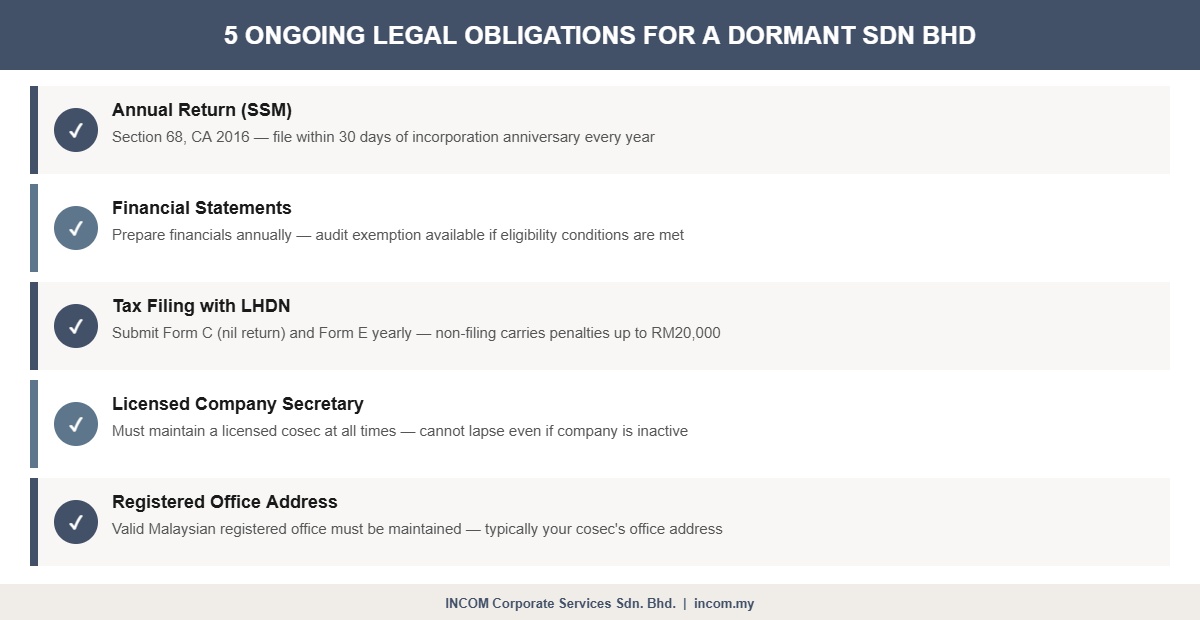
This is the section most business owners overlook. Dormant status does not mean zero responsibility. Here is what the law still requires.
1. Annual Return Filing with SSM
Under Section 68 of the Companies Act 2016, every company — dormant or otherwise — must lodge an Annual Return with SSM within 30 days from the anniversary of its incorporation date. The Annual Return confirms your company’s registered details: office address, directors, shareholders, and business nature.
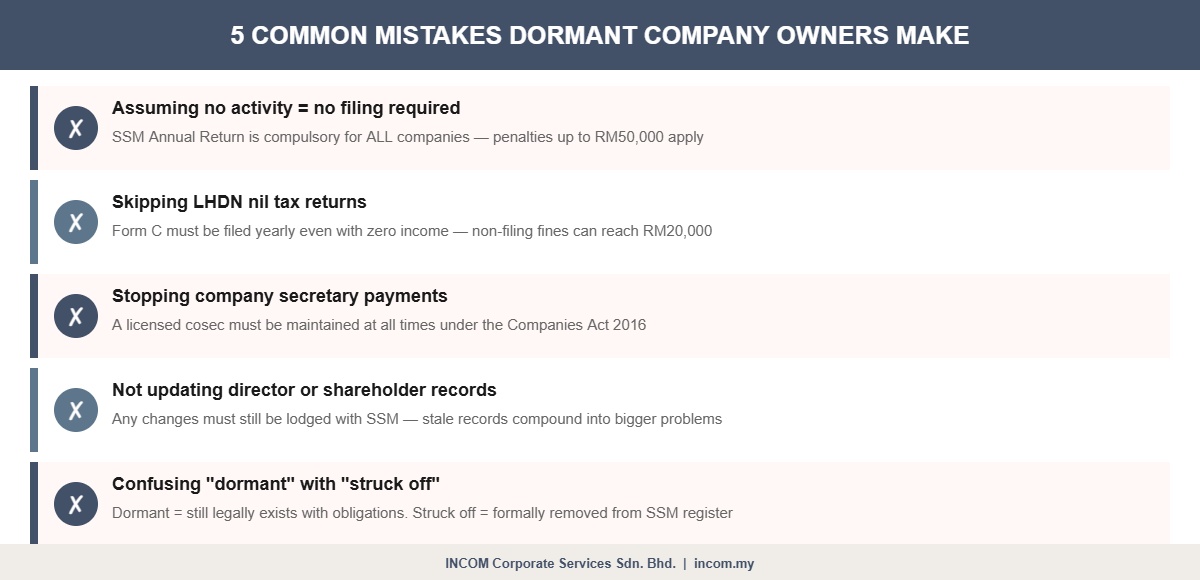
Failure to file carries penalties of up to RM50,000. This is one of the most commonly missed obligations among dormant company owners who assume inactivity means no filing is required — it does not.
2. Financial Statements
Dormant companies are generally still required to prepare financial statements. However, a dormant Sdn Bhd that meets the criteria under the Companies Act 2016 may be exempted from the audit requirement — meaning the financial statements do not need to be audited by an external auditor.
To qualify for the audit exemption, the company must fulfilled the conditions in Practice Directive No. 3/2017 (PD 3/2017) or Practice Directive No. 10/2024 (PD 10/2024).
For a Sdn Bhd in Malaysia, the financial statements must be lodged with the Companies Commission of Malaysia (SSM) within 30 days after they have been circulated to members/shareholders.
Financial statements must be circulated to shareholders within 6 months of your FYE. (For your first year, the preparation deadline is within 18 months from incorporation).
3. Tax Filing with LHDN
Even with zero income, your company must submit a tax return (Form C) to Lembaga Hasil Dalam Negeri (LHDN) for each year of assessment — declaring “NIL” income where applicable.
Dormant companies may apply to LHDN for a waiver from submitting audited financial statements, and in some cases, LHDN may acknowledge the dormant status and reduce the ongoing filing burden. However, you must notify LHDN proactively — this waiver is not granted automatically. Until LHDN confirms the exemption in writing, you remain liable to file Form C annually.
Additionally, Form E (the employer’s annual return) must still be submitted every year, even if the company has zero employees.
Failure to file tax returns — even nil ones — can result in penalties of up to RM20,000, late payment interest, and potential LHDN investigation. The tax authority does not treat dormant companies differently from active ones when it comes to filing deadlines.
4. Maintaining a Licensed Company Secretary
Every Sdn Bhd — including dormant ones — must maintain a licensed company secretary at all times under the Companies Act 2016. The secretary must be a member of a recognised professional body and must have their principal place of residence in Malaysia.
Allowing your company secretary appointment to lapse while the company is dormant is a breach of the Act, regardless of whether the company is active.
5. Maintaining a Registered Office
Your Sdn Bhd must maintain a valid registered office address in Malaysia at all times. The registered office is typically the address of your company secretary’s office, and all official SSM correspondence and notices will be directed there.
What Are Your Options?
If your company has been inactive and you are wondering what to do next, you broadly have three paths:
Option 1: Maintain Dormant Status and Stay Compliant
If you intend to resume operations in the future — or want to preserve the company name, licences, or structure — you can keep the company in its dormant state while continuing to meet your SSM and LHDN obligations. This involves annual return filings, maintaining your company secretary and registered office, and submitting tax returns.
This is a sensible option if the company holds value (a good name, an asset, or future plans) or if activity may resume within a few years.
Option 2: Strike Off the Company
If the company has no remaining purpose, you can apply to SSM to have it struck off under Section 551 of the Companies Act 2016. This permanently removes the company from the register and ends all ongoing compliance obligations.
Eligibility conditions apply — the company must have no outstanding liabilities, no pending legal proceedings, and typically all overdue filings must be resolved before SSM will approve the application. A company secretary will assess your eligibility and manage the application.
Option 3: Members’ Voluntary Winding Up
For companies with remaining assets, shareholders, or more complex structures, a formal winding-up process may be more appropriate than a strike-off. This involves a licensed insolvency practitioner and follows a statutory procedure to distribute assets and formally dissolve the company. This path is typically relevant for larger or more structured dormant entities.
Why Staying Compliant Matters — Even for a Dormant Company
Maintaining compliance for a dormant company is not just about avoiding fines. It protects your future options. If you ever want to reactivate the company, having clean and up-to-date records with SSM and LHDN makes the process far simpler. Conversely, if you want to close it, all filings typically need to be resolved before SSM will approve a strike-off — meaning past neglect becomes a current problem you have to solve before moving forward.
Staying compliant also preserves your credibility as a director. Directors who allow their companies to accumulate SSM penalties or overdue filings can be personally fined, and in serious cases, disqualified from serving as directors of other companies.
How INCOM Helps Dormant Company Owners Stay on Track
At INCOM Corporate Services Sdn. Bhd., we regularly assist Sdn Bhd owners who have dormant companies and need professional guidance on their obligations. Whether your company has been dormant for one year or several, we can help you assess your current compliance position and put things right.
Our dormant company services include:
- Annual Return filing with SSM — filed on time, every year, without fail
- Assessing your eligibility for the dormant audit exemption under the Companies Act 2016
- Preparing and lodging the required board resolutions and notices with SSM
- Advising on LHDN nil return filing and dormant status notification
- Maintaining your statutory registers and keeping company records current
- Guiding you through the strike-off process if you decide to close the company
Managing a dormant company does not have to be complicated or expensive — but it does require the right professional support to ensure nothing is missed.
Frequently Asked Questions
Do I still need to file an Annual Return if my company is dormant?
Yes. Under Section 68 of the Companies Act 2016, all companies — including dormant ones — must lodge an Annual Return with SSM annually. There is no blanket exemption from this requirement based on inactivity alone.
Does a dormant company need to file a tax return with LHDN?
Yes. A dormant company must still file Form C with LHDN for each year of assessment, even with zero income. You should also notify LHDN of your dormant status and apply for the relevant waiver. Until LHDN formally acknowledges your dormant status, the standard filing obligations apply.
Can a dormant company be exempted from audit?
Yes, if it meets the eligibility criteria under the Companies Act 2016 — including being dormant throughout the financial year, not being a public or listed company, and not being a holding company or subsidiary of a public company. The exemption is not automatic; proper resolutions and notices must be filed with SSM. A licensed company secretary will determine whether your company qualifies and manage the process.
What is the difference between a dormant company and a struck-off company?
A dormant company is still legally in existence — it remains on the SSM register, has legal capacity, and carries ongoing compliance obligations. A struck-off company has been formally removed from the SSM register and no longer exists as a legal entity. They are entirely different statuses with different processes and consequences.
Take Action — Do Not Leave Your Dormant Company Unattended!
A dormant company in Malaysia is never truly off the hook. As long as your Sdn Bhd remains on the SSM register, your obligations under the Companies Act 2016 and the Income Tax Act 1967 continue — regardless of how long the company has been inactive.
The good news is that with the right company secretary by your side, managing a dormant company is straightforward and affordable. Whether you want to maintain it for future use or close it properly, the key is to act — not to leave it unattended and let penalties compound.
Contact INCOM Corporate Services today for a professional assessment of your dormant company’s compliance position. We will advise you on exactly what needs to be done — and handle it for you.