
Registering your Sdn Bhd is only the beginning. From the day your company is incorporated, a cycle of annual filings, record-keeping and document management begins — and your Company Secretary (CoSec) is the one keeping all of it on track.
This guide explains what annual compliance looks like for a typical Malaysian Sdn Bhd, and what your CoSec handles on your behalf.
The Two Main Annual Filings
Every Sdn Bhd has (2) two core annual filings that the Company Secretary manages each year:
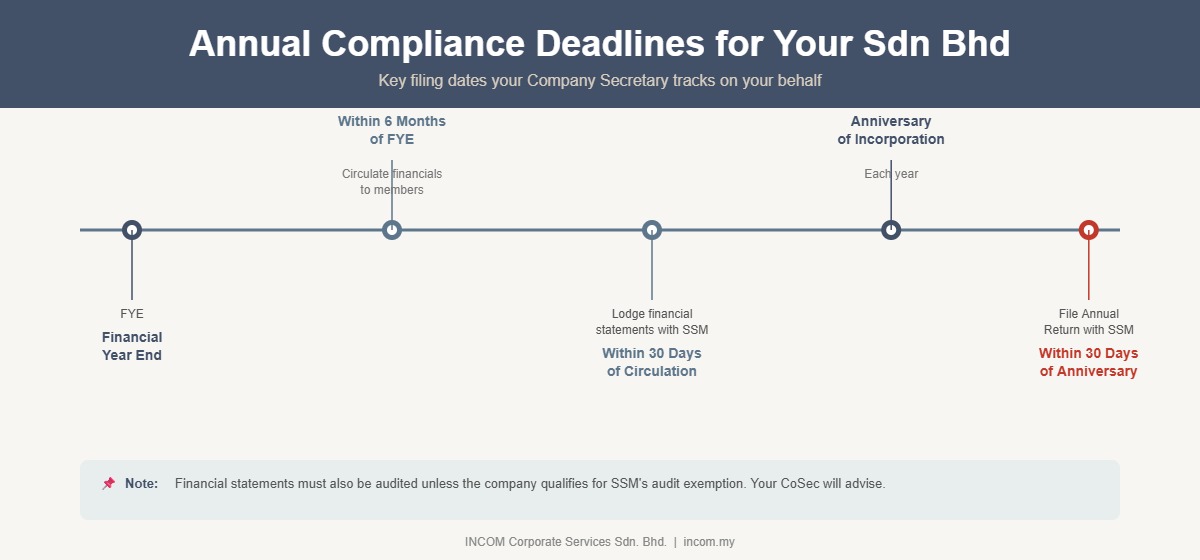
- Annual Return — lodged with SSM within 30 days of each anniversary of incorporation. This is a short statutory filing confirming the company’s details: its officers, shareholders and registered address.
- Financial Statements — circulated to members within 6 months of the financial year end (for a private company), then lodged with SSM within 30 days of circulation. Financial statements must also be audited unless the company qualifies under SSM’s audit exemption threshold.
Missing either deadline can result in penalties for the company and its directors. Your CoSec tracks these dates and ensures submissions are made on time.
What Is the Difference Between an Annual Return and an Annual Report?
These two terms are often confused — but they are very different documents:
- An annual return is a short statutory filing lodged with SSM confirming the company’s details — officers, shareholders, registered address and share capital.
- An annual report is a longer document mainly published by public listed companies, containing the full financial statements, directors’ report, and corporate governance disclosures.
A Sdn Bhd files an annual return and lodges financial statements — but does not publish an annual report in the listed-company sense. If someone asks whether your Sdn Bhd has an annual report, the answer is no; what you have is an annual return and a set of audited (or audit-exempt) financial statements on record with SSM.
What Statutory Records Does a Company Secretary Keep?
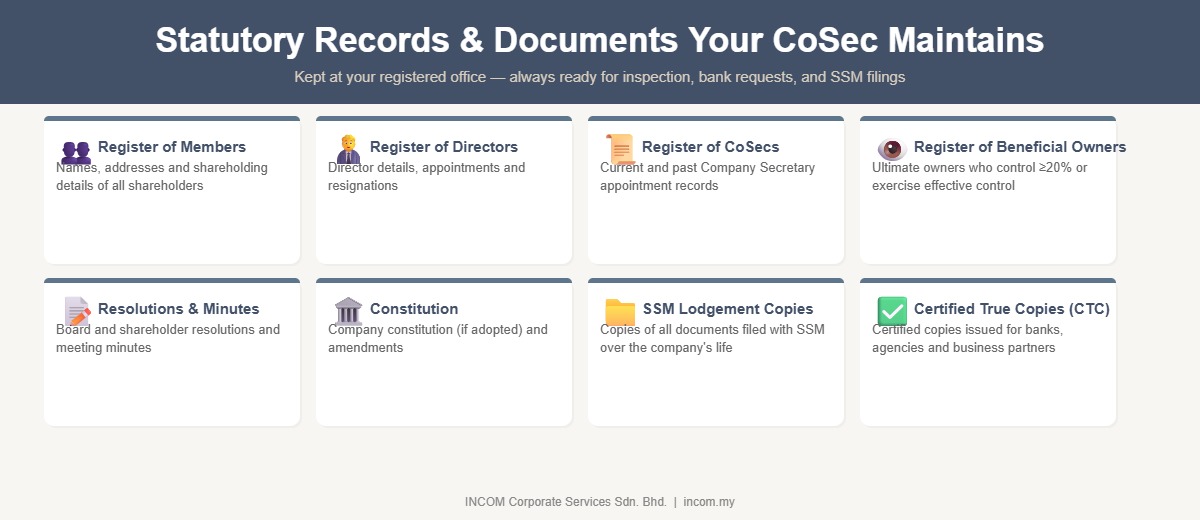
Beyond the annual filings, your Company Secretary maintains the company’s full set of statutory records, which must be kept at the registered office (or another notified location) and be available for inspection at any time. These include:
- Register of Members — names, addresses and shareholding details of all current and past shareholders
- Register of Directors — director details, appointment dates and resignations
- Register of Company Secretaries — current and former CoSec appointment records
- Register of Beneficial Owners — individuals who ultimately own or control the company
- Resolutions and Minutes — all board and shareholder resolutions, and minutes of any meetings held
- Constitution — the company’s constitution (if one has been adopted) and any amendments to it
- Copies of SSM lodgements — a complete set of documents filed with SSM over the company’s life
Documents, Signatures and Certified True Copies
Does a CoSec Have to Sign Company Documents?
It depends on the document. Certain SSM lodgements and certified copies require the Company Secretary’s signature. Most resolutions, however, are signed by the directors or shareholders — and then certified by the Company Secretary to confirm they are accurate records of the company’s decisions.
Do I Need Meeting Minutes for a Written Resolution?
No. A written resolution replaces a meeting, so no separate minutes are needed. The signed written resolution itself is the official record. Your CoSec will keep it in the company’s minute book alongside any other resolutions and meeting minutes.
Most private Sdn Bhds in Malaysia use written resolutions rather than holding formal board meetings — they are faster and just as legally valid.
What Are Certified True Copies (CTC), and When Do I Need One?
A Certified True Copy (CTC) is a copy of a company document — such as a resolution, the constitution or a register — that your Company Secretary certifies as a true and accurate copy of the original on file.
You will need CTCs regularly in the course of running your business. Common situations include:
- Opening a corporate bank account
- Applying for a business licence or government permit
- Entering into significant contracts or tenders
- Satisfying due diligence requests from business partners or investors
Banks and government agencies will almost always ask for CTCs rather than original documents. Your CoSec prepares and certifies these as part of the service.
Beneficial Ownership Reporting
Under the Companies (Amendment) Act 2024, every Sdn Bhd must maintain a Register of Beneficial Owners — a record of the individuals who ultimately own or control the company — and report this information to SSM.
These requirements were significantly tightened by the 2024 amendments, and your Company Secretary is now responsible for:
- Collecting beneficial ownership information from the relevant individuals
- Maintaining the internal Register of Beneficial Owners at the registered office
- Submitting and updating records via SSM’s e-BOS system
- Issuing notices to persons suspected of being beneficial owners when required
Enforcement has been active since 1 October 2024. If your company’s beneficial ownership records have not been reviewed since the amendments came into force, speak to your CoSec now.
How INCOM Can Help
Annual compliance is not a once-a-year task — it runs continuously throughout the company’s life, with deadlines, filings and record updates happening year-round. At INCOM Corporate Services, our licensed Company Secretaries track every deadline, prepare every document and lodge every filing on your behalf, so nothing falls through the cracks.
Contact us at incom.my to find out how we can keep your Sdn Bhd fully compliant — every year, without the stress.