
When you incorporate a Sdn Bhd in Malaysia, you may have noticed that a company constitution is listed as optional. Under the Companies Act 2016, private companies limited by shares are not mandatory to have one. So should you bother?
The short answer is: in most cases, yes — and the earlier you have one, the better. A well-drafted company constitution is one of the most powerful governance tools available to a Malaysian Sdn Bhd. It defines how your company is run, protects the interests of directors and shareholders, and prevents disputes before they arise. Without it, your company is governed entirely by the default provisions of the Companies Act 2016 — which are broad, generalised, and may not reflect how you actually want your business to operate.
This guide explains what a company constitution is, what it covers, when your company should adopt one, and how your company secretary plays a role in keeping it relevant as your business grows.
What Is a Company Constitution?
A company constitution is a legal document that sets out the objects, rules, and governance framework of a company. It governs the internal affairs and management of the company — covering everything from how directors are appointed and removed, to how meetings are conducted, how shares are transferred, and how decisions are made.
Under the Companies Act 2016, the constitution replaces what was previously known as the Memorandum and Articles of Association (M&A) under the old Companies Act 1965. Companies incorporated before January 2017 that had an M&A in place have three options:
- Continue using their existing M&A
- Abolish the M&A entirely, in which case the company defaults to being governed solely by the Companies Act 2016
- Amend the existing M&A or adopt a brand new constitution
Is a Company Constitution Mandatory in Malaysia?
For most companies, no. Under Section 31(1) of the Companies Act 2016, a constitution is optional for unlimited companies and companies limited by shares — which includes the majority of Sdn Bhd companies in Malaysia.
However, it is mandatory for companies limited by guarantee. These companies must lodge a constitution with SSM at the time of incorporation.
For Sdn Bhd companies that choose not to adopt a constitution, the Companies Act 2016 will serve as the default rulebook. While this is legally permissible, it means your company has no bespoke governance rules — only the generalised statutory framework designed to apply to all companies. This is rarely ideal for businesses with multiple shareholders, investors, or complex ownership structures.
What Happens Without a Constitution?
Without a constitution, your Sdn Bhd is governed entirely by the provisions of the Companies Act 2016. This is not necessarily a problem for a very simple, single-director, single-shareholder company — but it creates real gaps and risks for most others.
Specifically, a company without a constitution may face:
- Voting deadlocks: With an even number of directors or shareholders, tied votes cannot be resolved without a casting vote mechanism — which the Act does not provide by default.
- Unclear share transfer rules: The Act does not restrict who shares can be transferred to. Without a right of first refusal clause in your constitution, a shareholder can sell their shares to an outsider without offering them to existing shareholders first.
- Limited share structures: Without a constitution, a company can only issue ordinary shares. Preference shares — commonly used for investor fundraising — require a constitution to define their terms.
- Ambiguous board proceedings: The Act’s default provisions on board meetings and decision-making are general. Without specific rules tailored to your company, confusion and disputes can arise.
- No defined company objects: Without stated objects, the scope of your company’s business activities is undefined, which can create uncertainty in transactions and with counterparties.
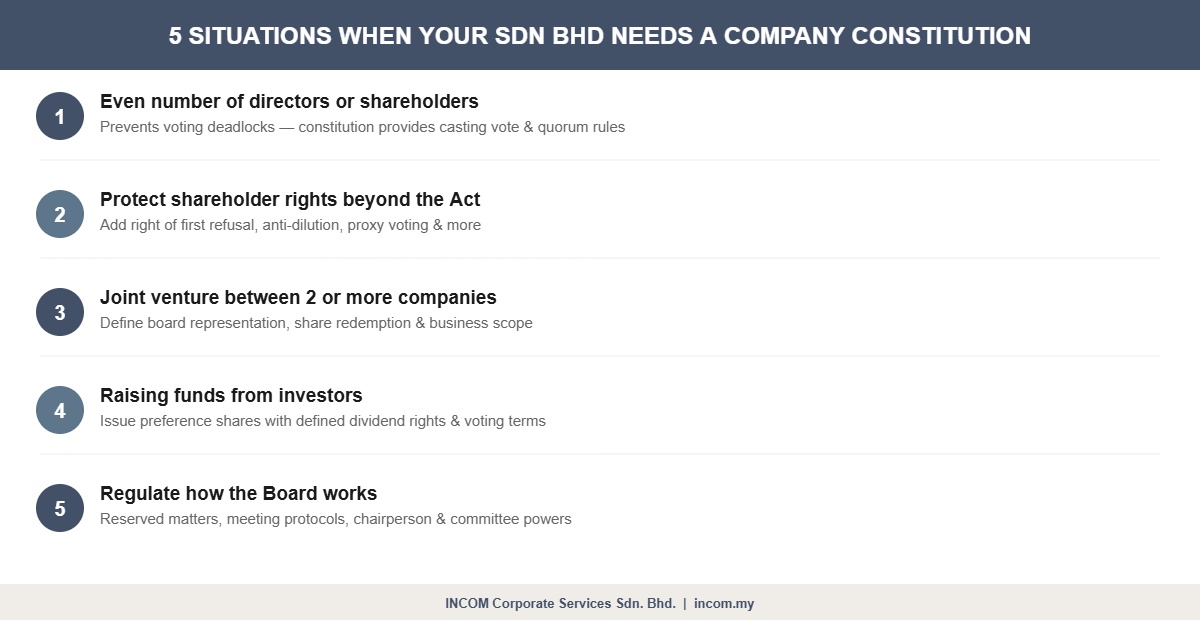
5 Situations When Your Sdn Bhd Should Adopt a Constitution
Key Clauses to Include in Your Company Constitution
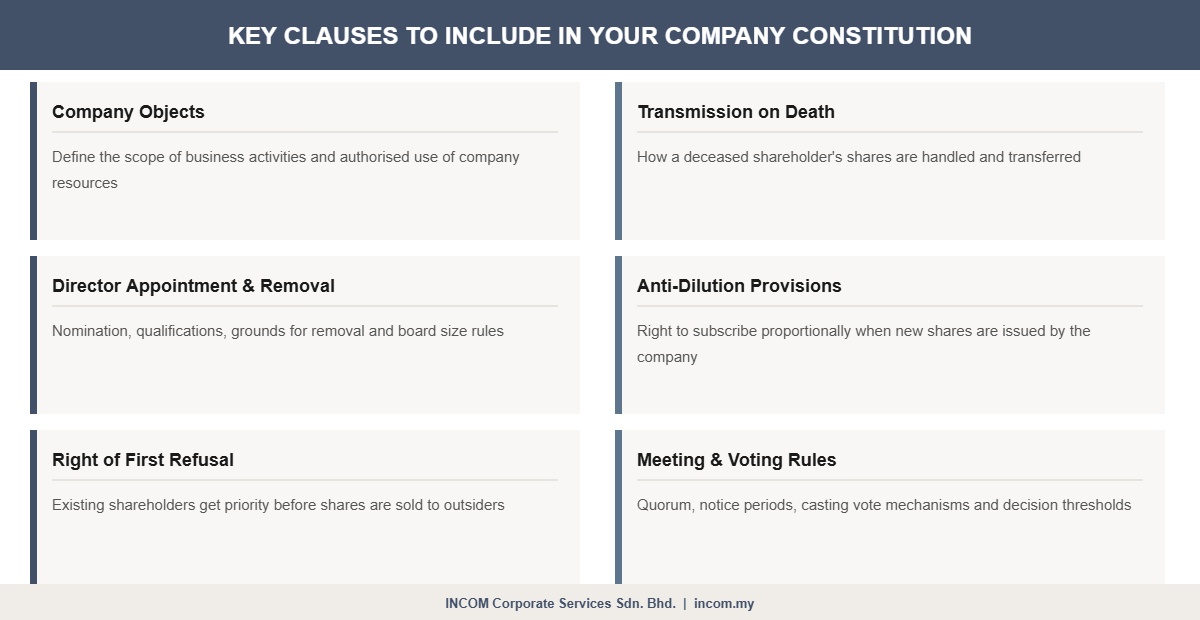
A well-drafted constitution goes beyond setting basic rules — it anticipates potential issues and provides clear, pre-agreed solutions. Key provisions to consider include:
Company Objects
Defining the scope of your company’s business activities provides certainty for directors, shareholders, and counterparties. It also reduces the risk of the company being used for purposes outside its intended scope.
Appointment and Removal of Directors
A clear procedure for appointing, retiring, and removing directors — including grounds for removal, nomination processes, and required qualifications — prevents disputes over board composition and ensures effective governance.
Share Transfer Restrictions and Right of First Refusal
Pre-emption rights protect existing shareholders by requiring a selling shareholder to offer their shares to other shareholders before transferring them to an external party. This prevents unwanted third parties from entering the company without the consent of existing shareholders.
Transmission of Shares on Death
Planning for the death of a shareholder is essential for business continuity. A transmission clause outlines how a deceased shareholder’s shares are dealt with — including who they pass to, whether board approval is required, and how the process is managed.
Anti-Dilution Provisions
Anti-dilution clauses protect existing shareholders from having their ownership percentage reduced when new shares are issued, by giving them the right to subscribe to new shares proportionally.
Meeting Protocols and Voting Rules
Provisions covering meeting frequency, notice periods, quorum requirements, voting rights, and record-keeping ensure that meetings are conducted properly and decisions are made with appropriate authority and transparency.
Is a Constitution the Same as a Shareholders’ Agreement?
No — they are different documents that serve different purposes, although they sometimes cover similar ground.
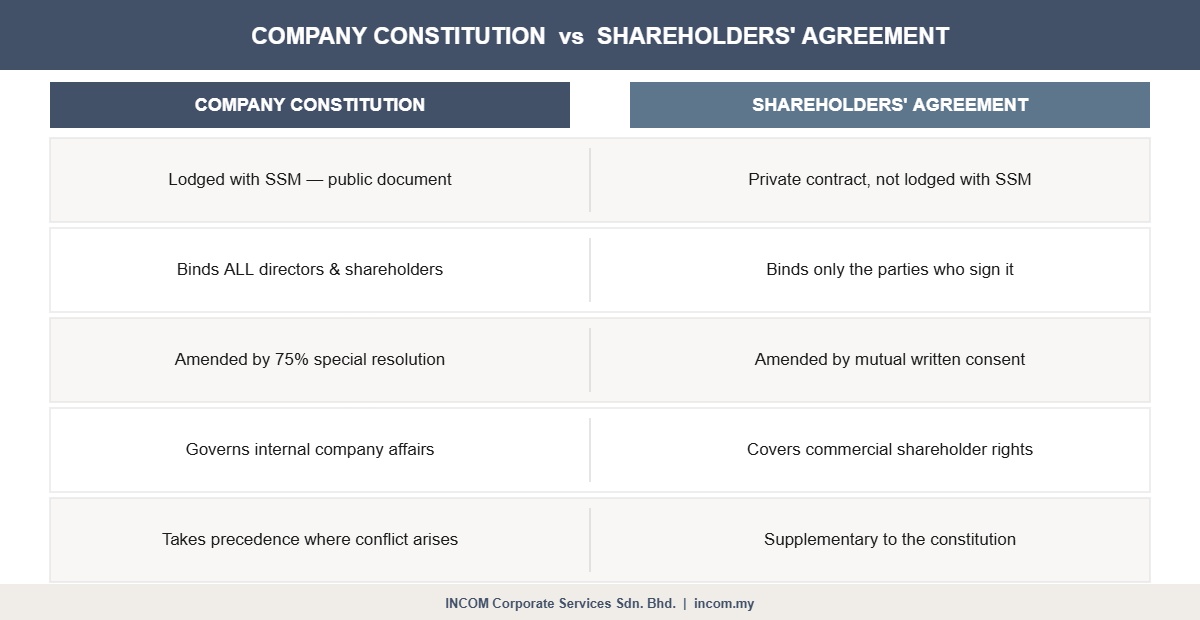
The constitution is a public document lodged with SSM. It binds the company, all its directors, and all its shareholders — whether or not they were shareholders when it was adopted. Amendments require a special resolution passed by at least 75% of members.
A shareholders’ agreement, by contrast, is a private contract between specific shareholders (and usually the company). It binds only the parties who sign it, and can be amended by mutual written consent without a special resolution. It typically focuses on the rights and obligations of shareholders in relation to their shares — matters like dividend policy, exit rights, tag-along and drag-along provisions, and non-compete obligations.
Many well-structured Sdn Bhd companies have both — a constitution for the governance framework, and a shareholders’ agreement for the commercial arrangements between shareholders. Where the two conflict, the constitution generally takes precedence.
How to Amend a Company Constitution
A company constitution is not set in stone. As the company grows and evolves, the constitution should be reviewed periodically and updated to reflect changes in the company’s structure, objectives, or circumstances.
There are two ways to amend a constitution under the Companies Act 2016:
- By special resolution: Under Section 36 of the Companies Act 2016, A majority of not less than 75% of members must vote in favour of the amendment. Once passed, the company secretary must notify and lodge the amended constitution with SSM within 30 days. The amendment takes effect from the date the resolution was passed, or such other date as specified in the resolution.
- By court order: Under Section 37 of the Companies Act 2016, a court may order an amendment where it is not practicable to do so by the standard procedure. The court order must also be lodged with SSM within 30 days.
The Role of Your Company Secretary in Relation to the Constitution
Your company secretary plays a central role in the life of your company constitution — from adoption through to any future amendments. At INCOM Corporate Services, we support our clients by:
- Advising on whether your Sdn Bhd should adopt a constitution, and what provisions are most relevant to your business structure
- Coordinating the preparation and adoption of a constitution — working with your legal advisors where required
- Preparing the board resolutions and special resolutions needed to formally adopt or amend the constitution
- Lodging the constitution or any amendments with SSM within the required 30-day timeframe
- Maintaining a copy of the current constitution in the company’s statutory records
- Flagging when the constitution should be reviewed — particularly following significant corporate changes such as new investors, share restructuring, or director changes
A company constitution is not a one-time document — it is a living framework that should evolve with your business.
Does Your Sdn Bhd Need a Constitution?
If your company has more than one director or shareholder, is considering bringing in investors, operates as a joint venture, or simply wants clarity and structure in how it is governed — the answer is almost always yes.
Even for a simple two-person Sdn Bhd, a constitution that addresses share transfers, voting deadlocks, and what happens in the event of a director’s death or departure can save enormous time, money, and conflict down the line.
The investment in getting a constitution right at the start — or at any point during the company’s life — far outweighs the cost of resolving a governance dispute without one.
At INCOM Corporate Services Sdn. Bhd., we advise Sdn Bhd owners on their governance structures and help them understand what a constitution should — and should not — contain for their specific situation. We work alongside legal professionals to ensure your constitution is not just compliant, but genuinely fit for purpose.
Contact INCOM today to discuss your company’s governance needs and find out how we can help you put the right structure in place.