
Transferring shares in a Malaysian Sdn Bhd is one of the most commonly needed — and most commonly mishandled — corporate transactions. Whether you’re bringing in a new investor, buying out a co-founder, restructuring ownership between family members, or exiting a business partnership, the share transfer process involves legal documentation, stamp duty payment, and updates to your company’s statutory register.
This guide explains exactly how share transfers work in Malaysia, what documents are required, how stamp duty is calculated, and the role your company secretary plays in making it legally valid.
What Is a Share Transfer?
A share transfer is the process of moving ownership of existing shares from one person (the transferor) to another (the transferee). Unlike a new share issuance — where the company creates new shares — a share transfer involves existing shares changing hands. The company’s total share count stays the same; only who owns them changes.
When Do You Need a Share Transfer?
Common situations that require a share transfer include:
- A co-founder is exiting the business and selling their stake
- You’re bringing in an investor who is buying shares from an existing shareholder
- Family restructuring — passing shares to a spouse, child, or other family member
- Settlement of a business dispute through an equity buyout
Key Documents Required
1. Share Transfer Form – Form Section 105 (Formerly known as Form 32A)
The primary document is Form Section 105 — the Instrument of Transfer under the Companies Act 2016. It records the name and details of the transferor (seller), the name and details of the transferee (buyer), the number of shares being transferred, and the consideration (price paid) or a confirmation that it is a gift. Both the transferor and transferee must sign this form.
2. Board Resolution
The company’s board of directors must pass a resolution to approve the share transfer, update the Register of Members, and cancel the existing share certificate while issuing a new one to the transferee, if so required.
3. Share Certificate
The original share certificate held by the transferor is surrendered and cancelled. A new share certificate is then issued to the transferee upon completion of the transfer..
Restrictions on Share Transfers
Pre-emption Rights
Most Sdn Bhd constitutions include pre-emption clauses — these give existing shareholders the right of first refusal before a shareholder can sell to an outside party. If your constitution includes this clause, the transferor must first offer the shares to existing shareholders at the proposed price. Only if all existing shareholders decline can the shares be sold externally. This step is often overlooked — but bypassing it can invalidate the entire transfer.
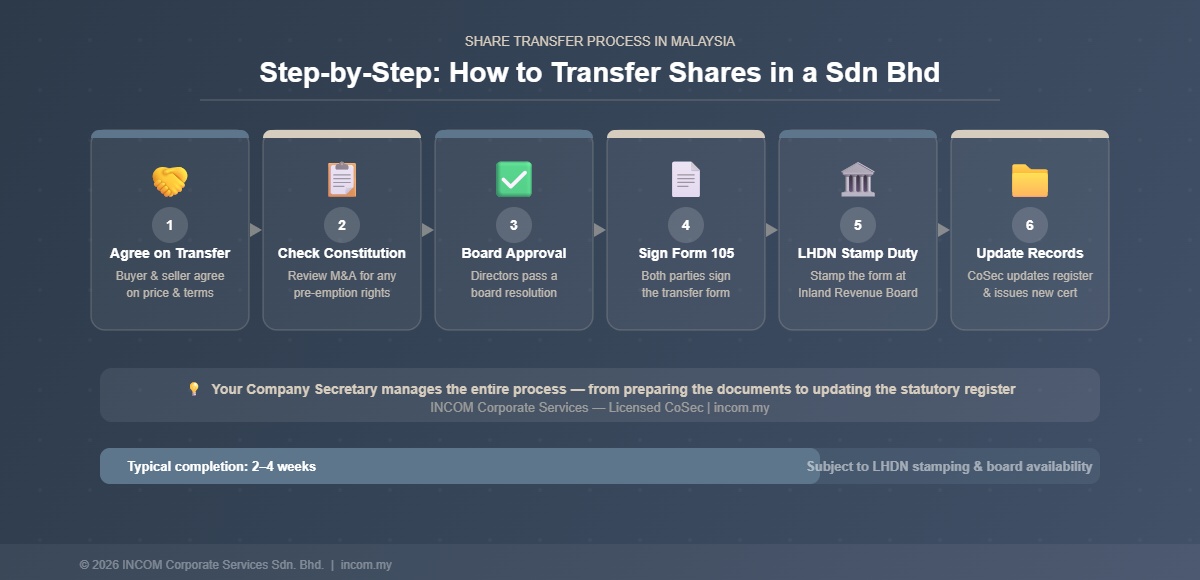
The Share Transfer Process: Step by Step
- Check the constitution (if any) — verify if pre-emption rights apply and follow the required offer procedure
- Agree on transfer price — both parties agree on consideration; ensure it reflects NAV to avoid stamp duty issues
- Prepare Form Section 105 — your company secretary drafts the Instrument of Transfer; both parties sign
- Pass board resolution — directors approve the transfer at a board meeting
- Pay stamp duty — submit Section 105 to LHDN for stamping; pay the assessed stamp duty
- Update statutory records — company secretary updates the Register of Members, cancels old share certificate, issues new one
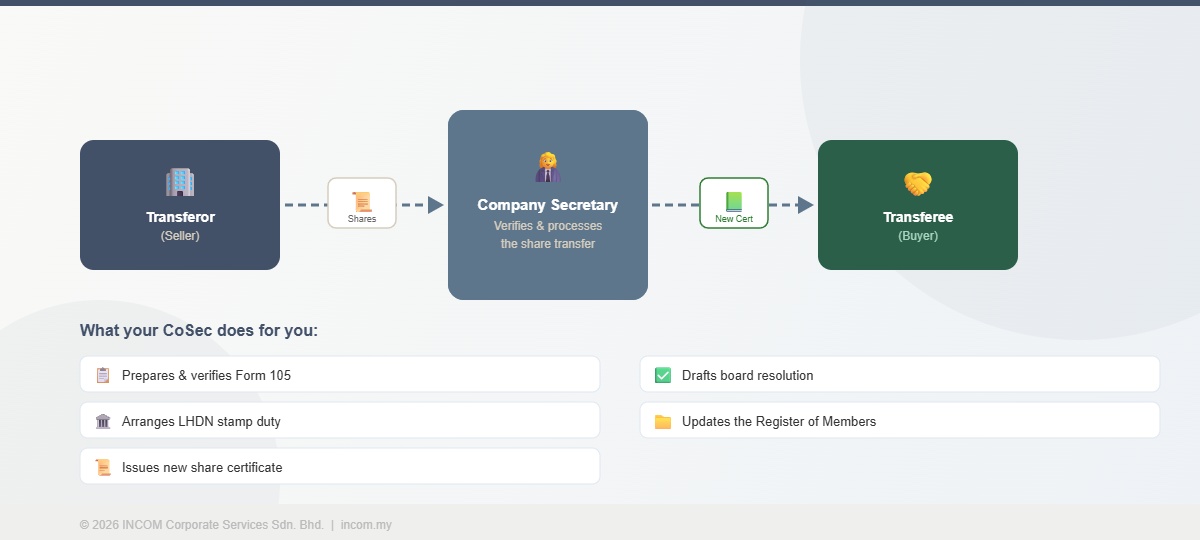
Role of Your Company Secretary in a Share Transfer
Many business owners assume a share transfer is simply a matter of signing a form and updating ownership records. Under the Companies Act 2016, it is a legal and compliance-driven process — and this is where your company secretary plays a critical role.
Every Malaysian Sdn Bhd is required to appoint a licensed company secretary registered with SSM. Without one, your share transfer may be legally invalid, rejected by SSM, or exposed to penalties. Here is what your company secretary handles:
1. Preparing and Verifying Transfer Documents
Your company secretary prepares and verifies all essential documents including the Instrument of Transfer (Form Section 105), the board resolution approving the transfer, and any share transfer agreement where applicable. They ensure accuracy, compliance with your company constitution, and proper execution by both parties.
2. Ensuring Compliance with the Company Constitution
Every Sdn Bhd may have specific restrictions on share transfers embedded in its constitution. Your company secretary checks pre-emption rights, confirms approval requirements, and ensures the transfer does not breach any internal rules. Skipping this step is one of the most common reasons a share transfer is later disputed or voided.
3. Advising on Stamp Duty Requirements
Your company secretary guides you on the correct stamp duty calculation, ensures documents are submitted to LHDN for stamping, and helps you avoid underpayment penalties that arise from understating the transfer value.
4. Drafting and Recording the Board Resolution
A share transfer must be formally approved by the board of directors. Your company secretary drafts the resolution, advises directors on their approval obligations, and ensures the decision is properly recorded in the company’s statutory records.
5. Updating Statutory Registers
After approval, your company secretary updates the Register of Members, share certificate records, and beneficial ownership records where applicable. This ensures that legal ownership is properly and accurately reflected in your company’s official registers.
6. Cancelling Old Certificates and Issuing New Ones
Once the transfer is complete, your company secretary formally cancels the old share certificate and issues a new certificate in the transferee’s name, with proper documentation and recordkeeping throughout, if so required.
Share Transfer vs Share Allotment: What’s the Difference?
| Share Transfer | Share Allotment | |
|---|---|---|
| What happens | Existing shares change ownership | New shares are created and issued |
| Effect on share count | No change | Total shares increase |
| Stamp duty | Yes — payable to LHDN | No stamp duty |
| Common use | Buyouts, restructuring, investor entry | Raising capital, ESOS |
Frequently Asked Questions
Can shares be transferred without the shareholder’s consent?
No. A transferor must voluntarily agree to transfer their shares. Shares cannot be taken from a shareholder without consent except through a court order in cases such as bankruptcy proceedings.
Can a foreigner buy shares in a Malaysian Sdn Bhd?
Yes, in most industries. Some regulated sectors such as agriculture, certain retail activities, and education have foreign equity caps. For most standard businesses, 100% foreign ownership via share transfer is permitted.
Do I need a lawyer for a share transfer?
You do not legally need a lawyer, but you do need a licensed company secretary to handle the statutory filings and register updates. For high-value or complex transfers involving shareholders’ agreements, legal advice is strongly recommended.
What happens to shares when a shareholder passes away?
Upon death, shares are transferred to the deceased’s estate and distributed according to their will or intestacy laws. The executor or administrator must apply to the company to be registered as the new shareholder, supported by a grant of probate or letters of administration.
Final Thoughts
A properly executed share transfer ensures smooth ownership transition, legal protection for both buyer and seller, full compliance with Malaysian regulations, and accurate company records for future audits or investment. Getting any step wrong — from pre-emption checks to stamp duty to statutory register updates — can result in an invalid transfer, penalties, or shareholder disputes.
INCOM Corporate Services handles share transfers for Sdn Bhd companies across Malaysia, ensuring every transfer is legally correct, properly stamped, and fully filed. Contact us to discuss your share transfer needs.