
Companies in Malaysia are subject to legal requirements under the Companies Act 2016 — but it is not realistic to expect shareholders and directors, whose expertise lies in running a business, to also be experts in statutory compliance. At the same time, the law does not accept ignorance as a defence. That is exactly where a Company Secretary comes in.
What Is a Company Secretary?
A Company Secretary — commonly called a CoSec — is a company officer appointed to keep the company compliant with the Companies Act 2016 and its filings with the Companies Commission of Malaysia (SSM).
We maintain statutory records, prepare resolutions, lodge changes and annual returns with SSM, and advise directors on their compliance obligations. Think of us as the company’s compliance backbone — making sure everything that needs to be filed is filed, and that the board always knows where they stand legally.
What Does “CoSec” Mean?
CoSec is a colloquial shorthand for Company Secretary, widely used in Malaysia — especially in informal settings. You will often hear company secretaries, directors and accountants use it interchangeably with the full title. Whether someone says “CoSec” or “Company Secretary”, they mean the same role.
Is a Company Secretary the Same as a Corporate Secretary?
Yes. “Corporate secretary” is the more common term in other countries, while Malaysia uses “Company Secretary” — but both terms describe exactly the same role. If you are working with foreign partners or shareholders, do not be confused if they use “corporate secretary”; they mean your CoSec.
How Is a Company Secretary Different from an Office Secretary?
An office or personal secretary provides administrative support — scheduling, correspondence, filing, and sometimes serving as a personal assistant to a senior executive. A Company Secretary is a professionally qualified statutory officer who keeps the company compliant with SSM and the Companies Act 2016.
The two roles share a name but very little else. (We used to get enquiries from people looking for office secretaries fairly often — thankfully those have tapered off!)
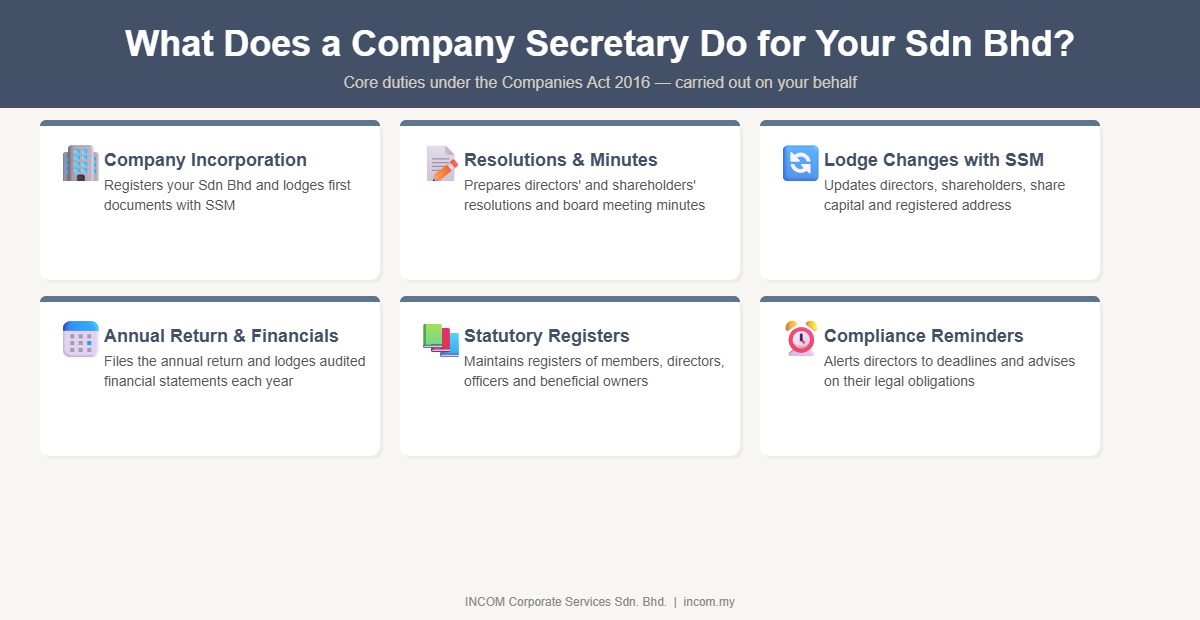
What Does a Company Secretary Do?
For a typical Sdn Bhd, a Company Secretary will, at a minimum:
- Incorporate the company and lodge its first documents with SSM
- Prepare directors’ and shareholders’ resolutions
- Lodge changes to directors, shareholders, share capital and registered address
- File the annual return and lodge financial statements with SSM each year
- Keep the company’s statutory registers up to date
- Remind directors of deadlines and advise on their compliance obligations
Depending on the company’s needs, a CoSec may also draft more complex resolutions and help coordinate with auditors and tax agents.
What Are a Company Secretary’s Duties Under the Companies Act 2016?
Sections 235 to 242 of the Act cover the appointment, qualifications and conduct of Company Secretaries. The Act requires the CoSec to help the company and its directors meet their statutory obligations, including:
- Keeping the registers of members, directors, officers and beneficial owners
- Lodging documents with SSM on time
- Recording meeting proceedings and resolutions
- Keeping statutory records at the registered office or another notified location
Is a Company Secretary a Director?
A Company Secretary is an officer of the company, but not a director. We do not make business decisions or vote at board meetings. Our job is to ensure the board’s decisions are properly recorded and that the company meets its legal obligations.
That said, a director can be appointed as CoSec if they are qualified — with one important caveat: where a document requires the signatures of both a director and a Company Secretary, the same person cannot sign in both capacities. This includes something as routine as a resolution to open a corporate bank account. So in practice, a sole director-shareholder Sdn Bhd should always have a separate, independent CoSec.
What Is the Company Secretary’s Relationship with the Directors?
The board appoints the Company Secretary, and the CoSec reports to the board. We advise directors on what the law requires, prepare and record resolutions, and act as the link between the company and SSM.
We are duty-bound to flag it when a board decision may breach the Act — but we have no power to override the board. That is why, when a board persistently acts against the CoSec’s advice on a serious compliance matter, it is not unusual for the CoSec to resign rather than remain associated with a breach.
Does a Company Secretary Handle Accounting and Tax?
No — bookkeeping, tax filing and audits are handled by accountants, tax agents and auditors. The Company Secretary works alongside them: for example, by preparing the resolution to approve the accounts and lodging the audited financial statements with SSM once they are ready.
Some firms offer all these services as a bundled package, but each function is carried out by a different qualified professional.
Legal Requirements: What Every Sdn Bhd Must Know
Does Every Sdn Bhd Need a Company Secretary?
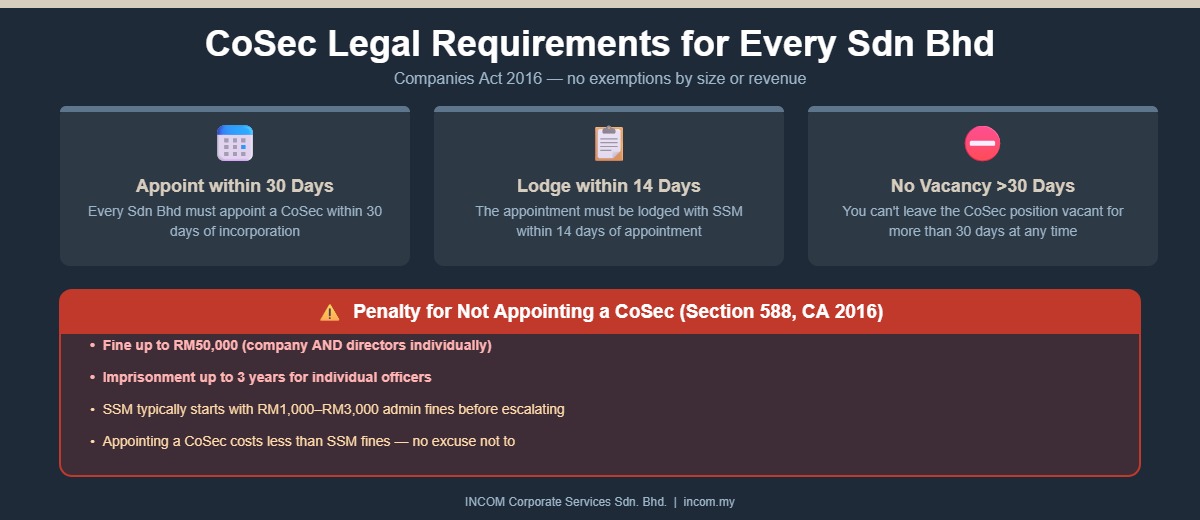
Yes — no exceptions. Every company incorporated under the Companies Act 2016 must have at least one Company Secretary. This includes a Sdn Bhd with just one director and one shareholder. There is no size or revenue threshold that exempts a company from this requirement.
How Soon Must a CoSec Be Appointed?
The first Company Secretary must be appointed within 30 days of incorporation, and the appointment must be lodged with SSM within 14 days of appointment. From then on, the position cannot be left vacant for more than 30 days at any time.
In practice, most companies have a CoSec from day one — because the Company Secretary typically handles the incorporation itself.
What Is the Penalty for Not Appointing a CoSec?
Failing to appoint a CoSec defaults to the General Penalty under Section 588 of the Companies Act 2016, which carries:
- A fine of up to RM50,000 — for both the company and its directors individually
- Imprisonment of up to 3 years for individual officers
- Or both
In practice, SSM rarely comes down hard on the 31st day. Most commonly, they begin with administrative fines of RM1,000 to RM3,000 as a warning to get moving. But the cost of appointing a CoSec is typically lower than even those initial fines — so there is simply no excuse not to have one in place.
Does a Sole Proprietorship or Partnership Need a Company Secretary?
No. Sole proprietorships and partnerships (SSM Enterprises) have significantly simpler compliance requirements and do not need a Company Secretary. This is one of the practical arguments in favour of choosing an Enterprise structure over a Sdn Bhd for very small businesses.
A Limited Liability Partnership (LLP) does not need a CoSec either — but it must appoint a compliance officer, which is effectively the same role under a different name.
Does a Company Secretary Need to Live in Malaysia?
Yes. A Company Secretary must be a qualified individual who is at least 18 years old, and their principal place of residence must be in Malaysia. This applies even for fully foreign-owned Sdn Bhds — and is why foreign owners almost always engage a local Company Secretarial firm.
Types of Company Secretary
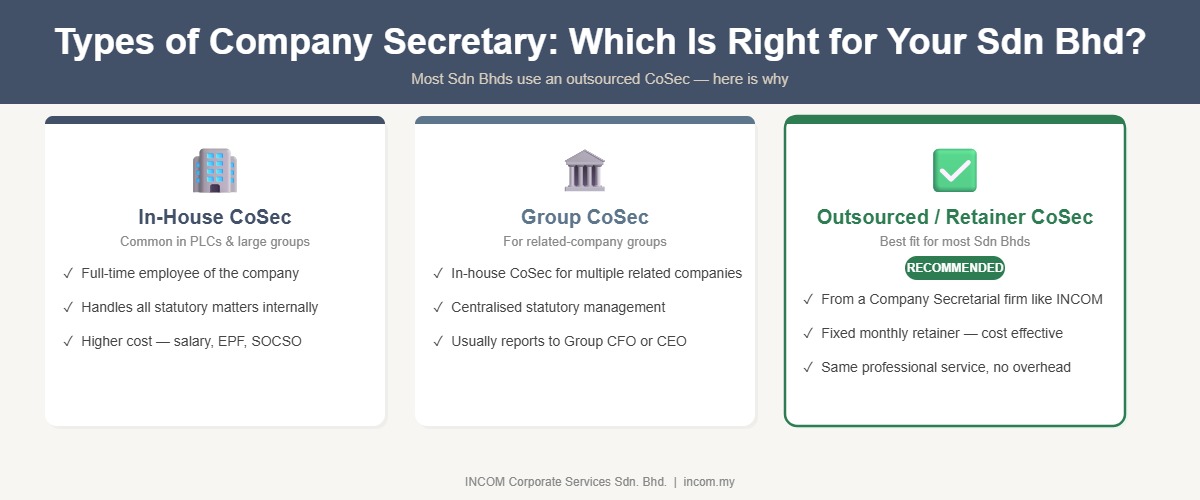
There are three main arrangements for how a company can have its CoSec function handled:
- In-house Company Secretary — a full-time employee of the company. Common in public listed companies and large corporate groups where the volume of statutory work justifies a dedicated headcount.
- Group Company Secretary — an in-house CoSec who looks after multiple related companies within a group. They typically report to the Group CEO or CFO and centralise statutory management across the group.
- Outsourced / Retainer Company Secretary — a CoSec from a Company Secretarial firm, engaged on a monthly retainer. This is how the vast majority of Sdn Bhds in Malaysia handle it, and for good reason: you get the same professional service at a fraction of the cost of an in-house hire, with no EPF, SOCSO or payroll overhead.
More Things You Might Be Wondering
Can a Lawyer Be a Company Secretary?
Yes. Advocates and solicitors who are members of the Malaysian Bar, the Sabah Law Society or the Advocates Association of Sarawak are among the professionals who qualify to act as Company Secretary. Like every other CoSec, they must also register with SSM and hold a valid practising certificate.
Does a Company Need a Full-Time Company Secretary?
No. The Act requires a company to have a Company Secretary — not a full-time employee in the role. Most Sdn Bhds engage an outsourced Company Secretary on a retainer, which fully satisfies the legal requirement at a much more practical cost.
What Does a Company Secretary Do at Board Meetings?
The CoSec prepares the agenda and meeting notice, ensures the meeting follows the company’s constitution, records the minutes, and prepares any resolutions passed. Many private companies in Malaysia make decisions by written resolution rather than holding formal meetings — and the Company Secretary prepares those too.
Is a Company Secretary Personally Liable for the Company’s Debts?
No. A Sdn Bhd’s debts belong to the company, not its officers. A Company Secretary is not personally liable for the company’s debts simply by virtue of holding the role.
What Can a Company Secretary Be Held Liable For?
A Company Secretary can be personally liable as an officer in default — which is a fancy way of saying we can be held responsible for not doing our job properly. This includes:
- Failing to lodge required documents with SSM
- Making false statements in filings
- Acting without a valid practising certificate
How INCOM Can Help
At INCOM Corporate Services, we are a licensed Company Secretarial firm serving Sdn Bhds across Malaysia. We handle everything from company incorporation and annual returns, to director and shareholder changes, resolutions and SSM correspondence — so your directors can focus on running the business while we keep it compliant.
Get in touch at incom.my to find out how we can serve as your company’s CoSec.